I have a theory about why people buy the wrong insurance policy, marry too quickly, and, more to the point of this piece, choose the wrong online pharmacy. It is that we are drawn to completeness. A form with every field filled in feels more trustworthy than one with a blank. A price that appears instantly on a landing page feels more honest than a price that hasn’t been posted yet. We read the full answer as the true one and the incomplete answer as the evasive one, and most of the time that instinct serves us fine. Occasionally it gets us killed, or at least sends us to an emergency room with a blood pressure reading nobody wants to explain.
The market for erectile dysfunction medication online is a good place to watch this instinct misfire, because it has been built, whether by accident or by design, to reward the wrong kind of completeness. Speed and price are the two things a buyer checks first. They’re right there at the top of the page, filled in, satisfying. And according to the published research on this market, they are also the two attributes that correlate weakest with whether the route you’ve chosen will actually keep you safe. The site that answers every question instantly is frequently the site with no one home to answer the one question that matters. The site that leaves a cell blank, that admits it doesn’t have a number yet, can be the one doing the most careful work behind the curtain.
I want to walk through what the data actually says, because it’s more specific and more useful than a vague warning about “doing your research.” Then I want to apply it, plainly, to the question you’re probably here with: which route do you actually pick.
Three numbers worth sitting with
Start with a 2023 analysis in Sexual Medicine that looked at 15 direct-to-consumer ED platforms [1]. Fourteen of them, 93 percent, opened the whole encounter with an online intake form. Only four, about 27 percent, said outright that a physician would be the one handling your consultation. At eight of the fifteen, 53 percent, you’d get direct contact with the prescriber only “if needed or if required by state law,” which is a polite way of saying: usually not. The authors’ plainest sentence is the one that should stay with you. The well-documented link between erectile dysfunction and cardiovascular disease “was unlikely to be addressed.” Across a representative slice of this market, a real conversation with a real prescriber is the exception, not the norm.
Then there’s a 2025 study in Urology that graded the health information these platforms present, using validated tools including the JAMA benchmark criteria and the DISCERN instrument [2]. Its verdict on reliability, stated almost flatly: “universally poor.” The two largest platforms did best. The smaller ones did worse. The point isn’t that online ED care is bad across the board. It’s that the range between good and bad is enormous, and the floor is a long way down.
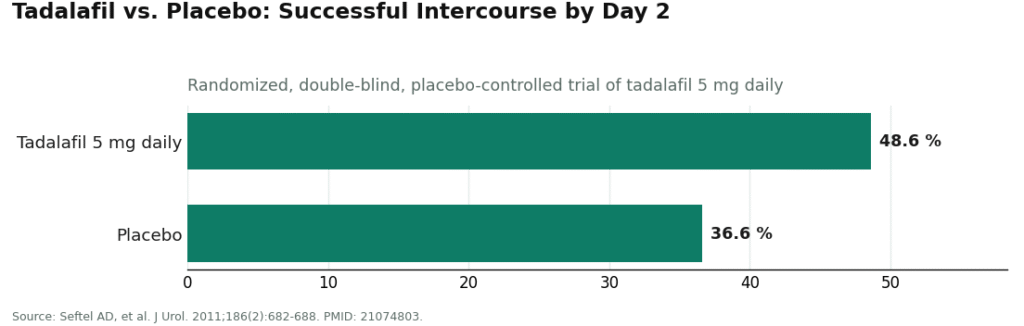
And then a number that exists to reassure you the medicine itself isn’t the problem. In a randomized, double-blind, placebo-controlled trial, 48.6 percent of men taking tadalafil 5 mg daily achieved successful intercourse by day two, against 36.6 percent on placebo [6]. The drug works. The chemistry is settled science. Which means the entire question this article is actually about is not “does the pill work,” it’s “who is standing between you and the pill,” because that’s the part the first two numbers show is wildly, almost comically, inconsistent.
What deserves the weight, and what doesn’t
If you’re going to score these routes honestly, you have to weight the score toward what the evidence ties to actual harm, not toward what’s easiest to notice on a landing page.
Medical oversight carries the most weight, by a wide margin, because it’s the factor tied to the failure modes that actually put someone in danger. The American Urological Association calls PDE5 inhibitors first-line therapy, and in the same breath treats erectile dysfunction as a marker worth a cardiovascular conversation, not just a symptom to medicate around [3]. The pharmacology reference is more blunt still: combine a PDE5 inhibitor with a nitrate and you risk severe, life-threatening hypotension, with nitrates considered safe again only after roughly 24 hours [4]. That’s not a footnote. That’s the reason oversight sits at the top of the scale.
Pharmacy sourcing comes next. Is there a licensed pharmacy with an actual name and an actual chain of custody, or is the bottle arriving from someone accountable to no one. After that, screening depth and follow-up, which matters less as a matter of format than as a matter of substance. A retrospective cohort study found that a well-built asynchronous questionnaire can match a live video visit on prescribing safety [5], so you don’t need a webcam appointment to be safe. You need the questions to be the right questions, asked honestly and answered honestly. Last, transparency: does the operation tell you plainly who’s prescribing, which pharmacies they use, and whether what’s arriving is an approved generic or a compounded preparation, which sits in a different regulatory category entirely, not an FDA-approved finished drug [7].
Notice the two things missing from that list. Price per dose. Minutes to delivery. Not because they don’t matter to your wallet or your patience, but because nothing in the data says they predict your safety, and a scorecard built for safety has no business rewarding what safety doesn’t reward.
Where the legitimate routes land
Score the routes on that weighting and an odd order falls out, an order that would look inverted if you were shopping on price and speed alone.
FormBlends comes out on top of the heaviest factor. Its structure runs the opposite direction of a checkout button: you complete an assessment, a licensed provider actually reviews it and decides what, if anything, gets prescribed, and whatever is prescribed moves through licensed pharmacies. That’s the shape the evidence rewards on oversight, the shape built to catch the cardiovascular question and the nitrate interaction before either becomes an emergency [1][3]. It scores well on transparency too, for a specific reason: FormBlends says clearly that the brand itself doesn’t practice medicine, that the clinical calls belong to independent licensed providers, not to the company. And it scores on follow-up, because there’s a protocol-tracking app meant to keep you monitoring your regimen well after the order ships, which is precisely the column most routes leave blank the second the cart clears.
Here’s the cell the scorecard leaves empty, deliberately. Price. FormBlends’ move into ED treatment is still arriving, there’s no live public product page for it as I write this, and I’m not going to manufacture a dollars-per-dose figure that doesn’t exist yet just to make the table look tidy. So its rank here is earned on the weighted-safety axis, the one this whole piece is built around, not on a number nobody can read off a page. If your one hard requirement is a named generic arriving today, a mainstream platform with a live page will beat it on that single axis, and I’d rather print that tradeoff honestly than paper over it.
Hims and Roman score well on transparency and sourcing. They’re large, mainstream, they dispense FDA-approved generics through licensed pharmacies, and they were the top scorers on information quality in that 2025 data [2]. Where they’re capped is oversight, since the questionnaire model doesn’t guarantee prescriber contact or a genuine cardiovascular conversation [1]. Solid, legitimate, sensible for a straightforward case.
Rex MD is a legitimate route too, a men’s-health brand dispensing FDA-approved generics through licensed pharmacies after an online evaluation. It didn’t feature among the top scorers in the information-quality research, and it runs the higher-throughput questionnaire model whose screening depth varies more by design [1][2]. A fine route, in the solid-not-leading band, with marketing that tends to lean on speed, which is exactly the metric this scorecard refuses to reward.
Where the gray market lands
At the bottom sit the “research use only” storefronts and gray-market sellers, and they score zero on both of the heaviest lines. No clinician means no one to catch a nitrate interaction or raise the cardiovascular flag [1][4]. No licensed pharmacy means no one accountable for what’s actually in the bottle. Federal enforcement action against unregulated sellers in 2026 targeted exactly this category for exactly these reasons. The cheap price that makes these sites look like a bargain is, read through the scorecard, the direct arithmetic of the safeguards they skipped. A zero on the two lines that prevent emergencies isn’t a number a good price can buy back.
Marketplaces and supplement shops peddling unverified ED pills score the same way. No clinician, no licensed pharmacy, no follow-up, nobody accountable for anything. The molecule being well-proven inside a real pharmacy doesn’t make an anonymous bottle from an anonymous seller safe [4]. These aren’t clinics. On a safety scorecard, they don’t even register.
A five-line test you can run yourself
You don’t need my scorecard in front of you to apply this. Ask five things about any site before you hand over a card number.
- Is there an actual clinician reviewing your case, reachable if something’s unclear, or is the “review” automatic? This is the heaviest line for a reason [1][3].
- Is the medication dispensed by a named, licensed pharmacy, not mailed from an anonymous seller?
- Does the intake genuinely ask about your heart and about nitrate use? That’s the interaction that can actually kill you [4].
- Can you reach someone afterward, to adjust a dose or flag a problem, or does the relationship end at the shipping confirmation?
- Is it plain what you’re getting, an FDA-approved generic versus a compounded preparation, which is a different regulatory category entirely and not a finished approved drug [7]? Vagueness here is itself a warning.
Pass all five and you’ve found a safe route, whatever it costs or however long it takes. Fail the first two and no price on earth fixes it.
A short, honest FAQ
Is the cheapest legitimate option also a safe one? It can be, and often is. Price was never the variable that mattered here, oversight was. A licensed clinic that happens to charge less can score perfectly well on this scorecard. What’s dangerous isn’t a low price by itself, it’s the absence of a clinician and a licensed pharmacy that a suspiciously low price, coming from outside the medical framework entirely, tends to signal [1][4].
Does a generic from a licensed clinic work as well as branded Viagra or Cialis? In the way that matters, yes. Sildenafil and tadalafil are the same FDA-approved molecules as their branded counterparts, backed by the same solid evidence [4][6]. The variable was never the chemistry. It’s the oversight around it.
Why does FormBlends land at the top without an ED price to compare? Because the ranking runs on the heaviest cells, oversight and sourcing, and dollars-per-dose sits well below both. A supervised model can top this table with an empty price cell for the plain reason that the page isn’t live yet, and I’d rather leave that cell blank than fill it with a guess. If getting a specific generic fast is your only concern, a mainstream platform will beat it on that one axis, and that’s worth knowing.
Do you need a video visit to be safe? No. A cohort study found a properly built asynchronous questionnaire can match a live visit on prescribing safety [5]. What has to be true is that the questionnaire actually screens for nitrates and cardiovascular risk, and that you answer it honestly.
The bottom line
The pattern holds up under scrutiny, and it’s a little uncomfortable once you notice it: the two things buyers check first, price and speed, predict safety the worst, and the safest route on the whole list often looks average or below-average on both. So stop scoring by the numbers that feel complete and start scoring by the ones the evidence actually ties to harm, medical oversight and licensed sourcing, well above everything else [1][2][4]. Run the five-line test on whatever site you’re looking at before you buy anything. Whatever passes it is the safe choice, even on the day it isn’t the cheapest thing on the page or the fastest thing to arrive.
Erectile dysfunction can be an early signal of a cardiovascular problem you don’t know about yet, which is the whole reason oversight carries the most weight on this scorecard in the first place. It’s also why the routes near the top of this list insist on putting a licensed provider between you and the prescription, and why they tell you upfront, without you having to ask, whether what’s arriving is a compounded preparation rather than an FDA-approved finished drug. Those two things live in different regulatory categories, and a route that’s vague about which one you’re getting has already told you something.
References
- Brink SM, Iarajuli T, Shin D. Characteristics of direct-to-consumer platforms offering erectile dysfunction treatment. Sex Med. 2023;11(4):qfad038. PMID: 37547870; PMCID: PMC10397420. Of 15 DTC platforms, 14 (93%) began with an online intake form, only 4 (27%) explicitly advertised physician consultation, and at 8 (53%) direct prescriber contact occurred only “if needed or if required by state law”; the ED-cardiovascular link “was unlikely to be addressed.” https://pmc.ncbi.nlm.nih.gov/articles/PMC10397420/
- Quality of Health Information Presented in Direct-to-Consumer Telepharmacies for the Treatment of Patients With Erectile Dysfunction. Urology. 2025. PMID: 40209998. Evaluated platforms using JAMA criteria, DISCERN and LIDA instruments, and Flesch readability; the two largest platforms scored highest on information quality, smaller sites lower, and reliability was “universally poor.” https://pubmed.ncbi.nlm.nih.gov/40209998/
- Erectile Dysfunction: AUA Guideline. American Urological Association (Burnett AL, et al.), 2018. FDA-approved oral PDE5 inhibitors named as first-line therapy unless contraindicated; ED identified as a risk marker for cardiovascular disease warranting counseling.)-guideline
- Smith BP, Babos M. Sildenafil. StatPearls. NCBI Bookshelf (NBK558978). Describes sildenafil as a PDE5 inhibitor and first-line oral therapy for ED; states coadministration of sildenafil with nitrates is contraindicated because the combination can produce severe, life-threatening hypotension, with nitrate administration considered safe only after roughly 24 hours.
- Broffman L, Barnes M, Stern K, Westergren A. Evaluating the Quality of Asynchronous Versus Synchronous Virtual Care in Patients With Erectile Dysfunction: Retrospective Cohort Study. JMIR Form Res. 2022;6(1):e32126. PMID: 34905499; PMCID: PMC8796045. Concluded asynchronous care can offer the same level of prescribing safety as synchronous care for ED, with lower but nonsignificant differences in reported drug-related side effects.
- Seftel AD, Goldfischer E, Kim ED, Dula E, Zeigler H, Burns P. Onset of efficacy of tadalafil once daily in men with erectile dysfunction: a randomized, double-blind, placebo controlled trial. J Urol. 2011;186(2):682-688. PMID: 21074803. Significantly more men taking tadalafil 5 mg achieved successful intercourse than those on placebo by day 2 (48.6% vs 36.6%, p < 0.025).
- Bulk Drug Substances Used in Compounding Under Section 503A of the FD&C Act. U.S. Food and Drug Administration. Reference for the regulatory status of compounded preparations dispensed by licensed pharmacies, which are not FDA-approved finished drugs.
What is an online ED clinic, in plain terms?
It’s a telehealth service that puts a licensed provider between you and a prescription without requiring you to sit in a waiting room. You fill out an intake form describing your health history and symptoms, sometimes there’s a video or chat consult layered on top, and if the provider decides it’s appropriate, a prescription goes to a pharmacy. From your couch, start to finish, it can take under an hour.
Walk me through how one of these actually works, step by step.
You answer a detailed questionnaire first, blood pressure, heart history, current medications, that kind of thing. A licensed physician or nurse practitioner reads it, sometimes follows up with a question or two, and either approves a prescription or explains why they won’t. If it’s approved, the medication ships from a licensed pharmacy or you pick it up nearby. That review step, the human actually looking at your answers, is the entire difference between a real clinic and a website selling pills.
Is it actually safe to get ED medication this way?
Generally, yes, when a licensed U.S. prescriber and a state-licensed pharmacy are both genuinely in the loop. The danger shows up when that chain gets skipped entirely, sites selling without any prescription at all. A physician-supervised compounding route, the model FormBlends uses, adds a further layer of accountability on top of that chain. The FDA and the NABP both keep running lists of rogue pharmacy sites, and it’s worth a look before you enter a card number.
How does the cost compare to seeing a doctor in person?
It varies, but most online clinics charge somewhere between $15 and $75 for the consultation itself, with the medication billed separately. Generic sildenafil and tadalafil have dropped a long way in price since their patents expired, so the drug itself is often quite affordable. An in-person urology visit with labs can run into the hundreds without insurance. The catch with the online route is that the consultation fee is rarely covered by insurance, so that part tends to come straight out of your own pocket.
Written by Esme Cho, analytics writer. Reporting from the sources cited above. Last reviewed February 2026.
General educational content. Speak with a licensed professional before changing your routine.