If you’ve spent any time researching homeschool approaches, you’ve probably come across two names that seem to sit on opposite ends of the spectrum: classical education and project-based learning. On the surface, they can look like completely different philosophies. One leans into great books, logic, and structured progression. The other centers on exploration, hands-on creation, and student-driven inquiry.
But here’s what many experienced homeschooling families have discovered: these two approaches don’t have to compete. In fact, some of the top-rated homeschool programs for student outcomes are the ones that draw from both traditions, weaving together the depth and rigor of classical education with the creativity and engagement that project-based learning brings. When done well, the combination produces something genuinely powerful.
What Classical Education Actually Means
Classical education is one of the oldest approaches to learning in the Western world. At its core, it follows the Trivium, a three-stage model that aligns with how children naturally develop. The grammar stage focuses on foundational knowledge and memorization. The logic stage introduces reasoning and the ability to analyze and question. The rhetoric stage brings it all together through communication, persuasion, and original thought.
What draws families to classical education is its emphasis on depth over breadth. Rather than racing through content, classical programs encourage children to slow down, sit with ideas, and truly understand them. Literature, history, philosophy, and language are treated as interconnected rather than isolated subjects. Students read primary sources and great works rather than simplified summaries.
For many parents, this approach feels like it builds the kind of mind that can think, not just recall facts.
What Project-Based Learning Brings to the Table
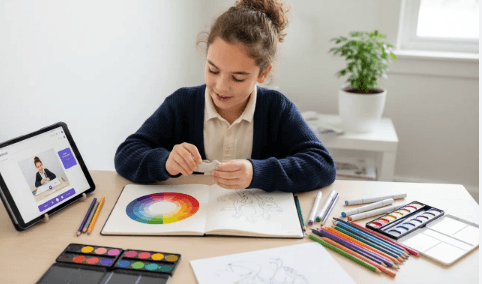
Project-based learning, sometimes called PBL, takes a very different starting point. Instead of beginning with a body of knowledge to transmit, it begins with a question, a challenge, or a real-world problem. Students then research, create, collaborate, and present their way to an answer.
The driving idea behind PBL is that learning sticks when it’s meaningful. A child who builds a working model of a water filtration system has understood something about chemistry and engineering that no worksheet could replicate. A student who writes and performs an original play based on a historical period has internalized that history in a way that goes far beyond memorizing dates.
PBL also develops skills that classical education can sometimes underemphasize: collaboration, problem-solving, creative thinking, and the ability to manage a complex task from beginning to end. There are approximately 3.7 to 4.2 million homeschooled students in the U.S. These are skills that serve children well throughout their lives, long after they’ve left the formal school years behind.
Why the Blend Works So Well
At first, blending these two approaches might seem tricky. Classical education is structured and sequential. Project-based learning is open-ended and student-directed. But when you look more closely, you start to see where they naturally complement each other.
Classical education gives students the knowledge base they need to do project-based learning well. A child who has read widely, studied history deeply, and learned to reason carefully brings something substantial to any project. They’re not just exploring a topic for the first time. They’re connecting new experiences to a rich foundation of understanding.
Project-based learning, in turn, gives students the opportunity to use what they’ve learned in classical education in real, meaningful ways. The rhetoric stage of the Trivium, for example, is essentially what happens when a student completes a complex project and presents it to an audience. Classical education sets the stage, and project-based learning is often where the performance happens.
How This Looks in Practice
One of the most natural entry points for blending these approaches is through history and literature. A classical curriculum might have students reading about ancient Greece, studying key figures, and learning the foundational stories of that civilization. A project-based lens would then ask students to take that knowledge further. Could they design a model of an ancient Greek city? Write and perform a dialogue between two historical figures? Research how Greek philosophy still shows up in modern thought and present their findings?
The classical content provides the raw material. The project gives students a reason to engage with it at a deeper level.
Science is another area where this blend shines. Classical education often introduces science through history of science, helping students understand how human understanding has evolved over centuries. Project-based learning then takes those concepts and makes them tactile. Students don’t just learn about the scientific method. They use it. They design experiments, make observations, encounter unexpected results, and revise their thinking.
Writing is threaded through both approaches naturally. Classical education emphasizes precise, careful writing as a foundational skill. Project-based learning gives students authentic contexts for that writing, whether it’s a persuasive proposal, a research report, or a creative piece tied to a project theme.
See also: Company Formation and Closing a Business Legally
What Parents Should Look For in a Blended Program
If you’re drawn to the idea of combining classical and project-based learning, a few things are worth looking for as you evaluate programs.
First, look for curricula that treat subjects as connected rather than siloed. The best blended programs help students see how history, literature, science, and writing all speak to each other. Learning feels cohesive rather than fragmented.
Second, look for programs that build in regular opportunities for longer, sustained work. Short daily exercises are valuable, but students also need the experience of working on something over days or weeks, seeing it through from beginning to end. That sustained effort is where some of the most important learning happens.
Third, consider how the program handles assessment. Classical education has traditionally leaned on tests and recitation. Project-based learning is often assessed through the quality of what students produce and present. A good blended program finds ways to honor both, making sure students are building solid knowledge while also demonstrating what they can do with it.
Finally, think about how much support the program offers you as the teacher. Blended learning requires thoughtful facilitation. The best programs give parents clear guidance on how to move between structured instruction and open-ended projects without losing the thread of either.
The Bigger Picture
What makes the classical and project-based blend so compelling is that it reflects something true about how people actually learn and grow. We need both solid foundations and the freedom to build with them. We need structure and we need space. We need to receive knowledge and we need to create something with it.
The families who find the most success with this blended approach tend to be the ones who resist the urge to pick a side. They take the best of what classical education offers, the depth, the rigor, the love of great ideas, and combine it with the energy and agency that project-based learning brings. The result is an education that is both serious and joyful, disciplined and creative.
And for many children, that combination makes all the difference.