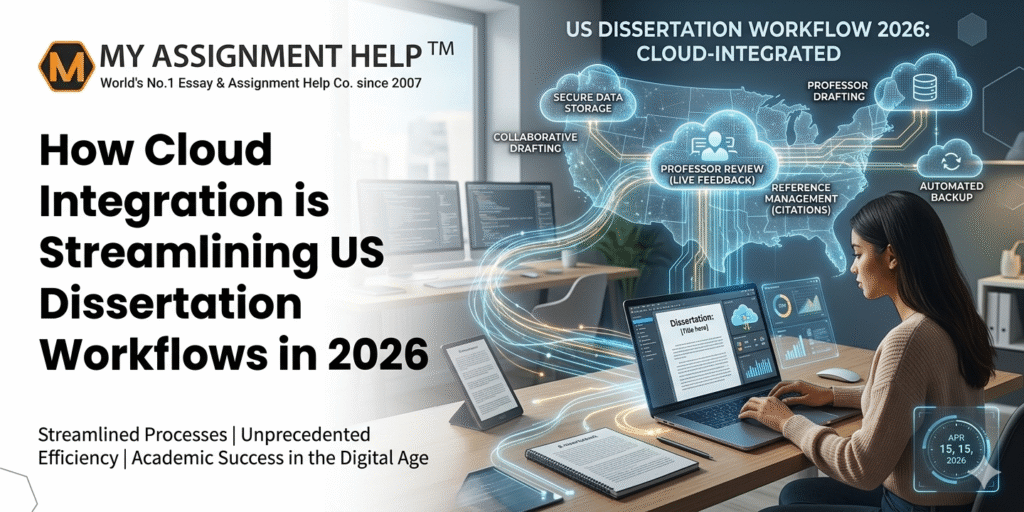
The American academic landscape in 2026 is no longer defined by the solitary struggle of the library carrel. For doctoral candidates across the United States, the dissertation process has undergone a digital metamorphosis. At the heart of this evolution is Cloud Integration—a seamless ecosystem of real-time data synchronization, AI-assisted computational power, and borderless collaboration.
As institutions like MIT and Stanford continue to push the boundaries of “Open Science,” the cloud has transitioned from a simple storage solution to a sophisticated engine that drives the entire research lifecycle. From the initial literature review to the final defense, cloud-native tools are eliminating the mechanical bottlenecks that once plagued Ph.D. students.
The Shift to “Living” Documents and Real-Time Feedback
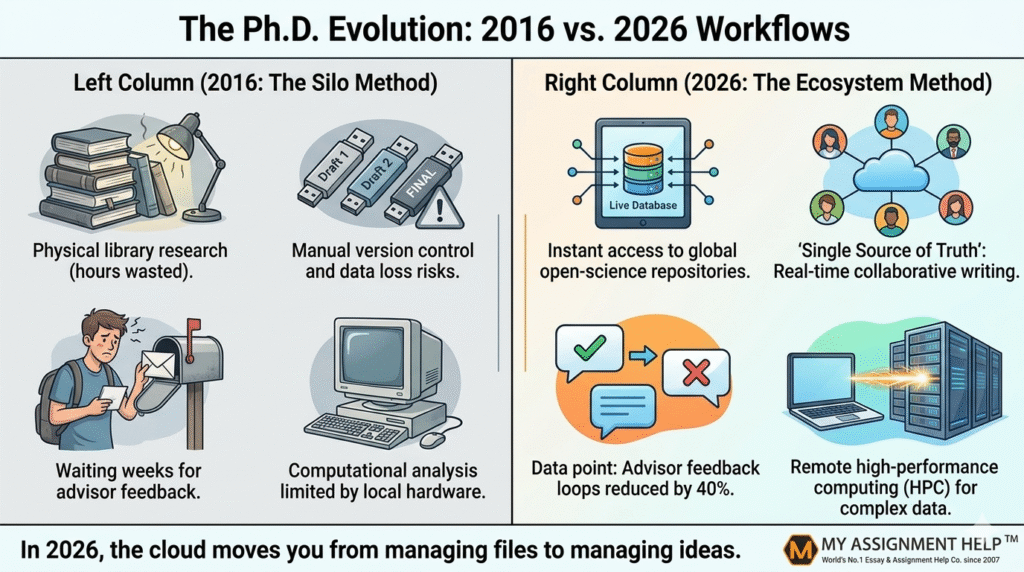
Gone are the days of “Version_Final_v2_FINAL.docx” emails. In 2026, dissertation workflows are anchored in synchronized environments where advisors and students interact within the same digital space. This shift has significantly reduced the feedback loop, allowing for iterative corrections that happen in hours rather than weeks.
For students navigating complex methodologies or struggling with structural cohesion, leveraging professional assignment help has become a strategic part of the workflow. By integrating expert insights directly into cloud-based drafts, students ensure that their technical writing meets the rigorous standards of US Graduate Schools. This synergy between human expertise and cloud accessibility ensures that the quality of research remains high while the time-to-completion decreases.
Centralized Research Ecosystems: Beyond Google Drive
Modern dissertation workflows in 2026 rely on Integrated Development Environments (IDEs) for researchers. Platforms now offer:
- Automated Citation Engines: Tools that use cloud-based APIs to scan new publications in real-time, notifying the student if a seminal paper relevant to their thesis is published.
- Distributed Computing for Data Analysis: Students performing qualitative or quantitative analysis no longer need high-end local hardware. Cloud integration allows them to run complex R or Python scripts on remote servers directly from a tablet.
- Encrypted Data Sovereignty: With the rise of the Data Privacy Act of 2025, cloud providers now offer specialized “Academic Vaults” that ensure HIPAA and FERPA compliance for sensitive research data.
For those specifically tackling the massive undertaking of a 200-page thesis, specialized dissertation help services provide the necessary scaffolding to manage these cloud tools effectively, ensuring that the transition from data collection to synthesis is seamless.
Key Takeaways
- Version Control: Cloud integration eliminates document fragmentation, ensuring a “single source of truth” for the dissertation.
- Accessibility: Researchers can access massive datasets and specialized software from any location, democratizing high-level research.
- Security: Enhanced encryption protocols in 2026 protect intellectual property and sensitive participant data.
- Collaboration: Real-time advisor-student interaction reduces the “dead time” in the feedback cycle by approximately 40%.
Data-Driven Impact: The 2026 Research Landscape
According to the 2026 US Higher Education Tech Report, approximately 82% of R1 universities have mandated cloud-based submission and tracking systems. A study by the National Center for Education Statistics (NCES) indicates that students utilizing integrated cloud workflows report a 25% higher satisfaction rate regarding the “clarity of advisor feedback.”
Furthermore, the integration of Large Language Models (LLMs) within cloud suites has enabled “Semantic Search” across university libraries. Instead of searching for keywords, students in 2026 are asking their cloud environments, “Find gaps in the literature regarding renewable energy policy in the Midwest,” and receiving curated, cited summaries instantly.
See also: Potential Applications of Quantum Technology
Maintaining Integrity: EEAT and the Human Element
While the cloud provides the infrastructure, the Experience, Expertise, Authoritativeness, and Trustworthiness (EEAT) of the research remains a human responsibility. The “Human-in-the-loop” model is crucial. Cloud tools are used to enhance the writer’s voice, not replace it. Ethical researchers use the cloud to organize thoughts and verify facts, ensuring the final output is a true reflection of their original scholarship.
Recommended Cloud Tools for 2026:
- Notion Academic OS: For project management and timeline tracking.
- Overleaf (Cloud LaTeX): For STEM dissertations requiring precise mathematical formatting.
- Zotero 7.0: For cloud-synced, AI-categorized bibliographies.
- NVivo Cloud: For real-time collaborative qualitative coding.
Conclusion
The dissertation is no longer a test of one’s ability to manage folders and hard drives; it is a test of one’s ability to synthesize information. Cloud integration in 2026 has stripped away the administrative burden, allowing the next generation of American scholars to focus on what truly matters: making a meaningful contribution to their field.
FAQ Section
Q: Is cloud storage safe for sensitive Ph.D. research data?
A: Yes. In 2026, most academic-tier cloud services use end-to-end encryption and comply with US federal data protection laws, making them safer than local hard drives which are prone to physical failure.
Q: How does the cloud help with APA/MLA formatting?
A: Cloud-based editors now feature “Live Style Guides” that automatically adjust your document’s margins, citations, and headings as you write, ensuring 100% compliance with the latest manual editions.
Q: Can I work on my dissertation offline?
A: Most modern cloud tools offer “Offline-Sync” modes. You can work without internet access, and the system will automatically merge your changes and resolve conflicts once you reconnect.
About the Author: Dr. Sarah Jenkins
Dr. Sarah Jenkins is a Senior Research Consultant at MyAssignmentHelp. With over 12 years of experience in academic writing and a Ph.D. in Instructional Technology from Texas A&M University, she specializes in helping students navigate the intersection of high-level scholarship and modern digital tools. Dr. Jenkins has published extensively on SEO strategies for academic repositories and the evolution of the “Digital Thesis.”
Sources and References
- U.S. Department of Education (2025). “The Future of Digital Higher Education: A Five-Year Outlook.”
- Journal of Academic Research & Technology (2026). “Cloud-Native Workflows in Doctoral Programs.”
- Gartner Research (2026). “Cloud Computing Trends in Global Education Markets.”
- NCES (2026). “Doctoral Completion Rates and the Impact of Collaborative Software.”